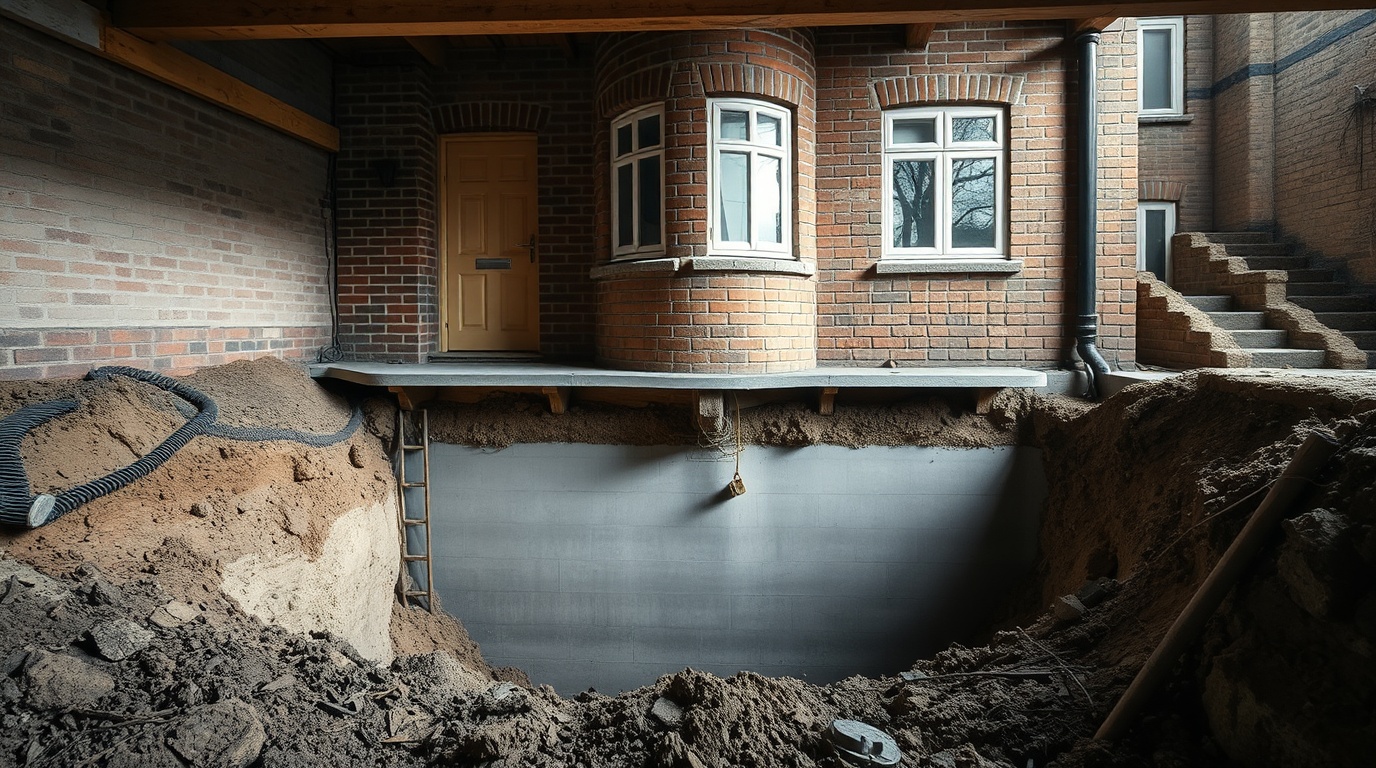
The short answer
Underpinning a chimney is a relatively localised job, so it usually costs less than underpinning a run of wall — commonly around £3,000–£8,000 where the chimney breast foundation genuinely needs support, though access and depth can push it higher. The figure depends on whether you are underpinning the foundation under a chimney breast at ground level or dealing with a leaning chimney stack at roof level, which are different problems. A structural engineer will first establish why the chimney is moving — foundation settlement, washed-out ground, or a leaking nearby drain — because the answer is not always underpinning. For a stack leaning at roof level, rebuilding or strapping the stack is usually the right and cheaper fix, while a settling breast at the base is the case where underpinning may apply. As always, the engineer's diagnosis decides the method and the cost.
A moving chimney needs the same diagnosis as any subsidence: find the cause first. Underpinning the breast foundation is one outcome; stack repair is another. The figures below are typical UK ranges for guidance.
Typical UK costs
- Underpin chimney breast foundation~£3,000–£8,000
- Leaning stack rebuild / strapoften cheaper, roof-level work
- Structural engineer diagnosisfrom ~£300–£600
- Causesettlement, ground, drains
- Methoddecided by the engineer, not assumed
Breast at the base vs stack at the roof
- Chimney breast at ground level: if the breast's foundation has settled — often because it was shallow or the ground beneath has moved — underpinning that foundation may be the fix, at roughly £3,000–£8,000 for the localised work.
- Chimney stack at roof level: a stack leaning above the roofline is usually a brickwork problem, not a foundation one. The fix is typically taking down and rebuilding the stack, or strapping and repointing, which is roof-access work rather than underpinning.
- Shared causes: a leaking drain near the chimney, clay shrinkage or removed vegetation can all drive movement, and fixing that cause is part of the cost.
| Problem | Likely fix | Typical figure |
|---|---|---|
| Settling breast foundation | underpin the foundation | £3,000–£8,000 |
| Leaning stack (roof level) | rebuild / strap stack | often lower, roof work |
| Drain-related movement | repair drain + monitor | varies with drainage work |
Indicative UK guidance. Sources: Checkatrade chimney and underpinning cost guides.
Get the cause diagnosed first
Because a leaning or cracked chimney can be a base problem or a roof problem, the first step is a structural engineer's assessment, from around £300–£600. They establish whether the movement is foundation settlement — which can point to underpinning — or brickwork and weathering at the stack, which does not. If the chimney movement is part of wider subsidence affecting the house, and you hold buildings insurance, it may fall within a subsidence claim, in which case the insurer manages and largely funds the work bar your excess. Underpinning a chimney in isolation is only the right answer once the engineer confirms the breast foundation is genuinely the issue.
What makes a chimney foundation move
When a chimney breast genuinely settles at the base, the causes mirror wider subsidence. Period chimney breasts were often built on shallow footings carrying a heavy masonry stack, so they are sensitive to ground movement. A leaking drain or rainwater gully near the chimney can wash out or soften the ground beneath it; clay shrinkage from a nearby tree dries the soil and lets the breast drop; and historic removal of a chimney breast internally without proper support can shift loads onto a foundation never designed for them. A structural engineer reads the crack pattern — whether it widens top or bottom, and whether it follows the junction between the breast and the main wall — to work out whether the movement is at the foundation or higher up. Only foundation-level settlement points toward underpinning; brick-level or load-path problems are solved differently.
| Cause | Typical remedy |
|---|---|
| Shallow footing settling | underpin breast foundation |
| Leaking gully / drain | repair drainage + monitor |
| Tree drying clay | manage tree + assess foundation |
| Internal breast removed unsupported | structural support to loads |
General UK guidance. Source: Checkatrade and structural engineering practice.
Doing the work and signing it off
If underpinning the chimney breast foundation is confirmed, the work follows the usual sequenced method — excavating and filling beneath the footing in short bays so the structure stays supported — but in a confined space around the breast, often inside the house, which can mean lifting floors. Because it is structural and notifiable, Building Control inspect it, and where the chimney sits on or near a party wall in a terrace or semi, the Party Wall etc. Act 1996 applies. Where the chimney movement is part of broader confirmed subsidence and you hold buildings insurance, it should be reported as part of that claim rather than fixed privately, so the insurer manages and largely funds the work bar your excess. Keep the engineer's completion certificate, as it evidences the repair for future buyers and insurers.
One useful distinction for homeowners is that chimney problems sit on a spectrum from purely cosmetic to genuinely structural, and the cost follows that spectrum. A little spalled brickwork or a weathered pot is maintenance; a stack leaning above the roofline is a bricklaying or roofing job; cracking that tracks down the breast and into the foundation is the structural end where underpinning may enter the picture. Reading where a particular chimney sits is exactly what the structural engineer's assessment is for, and it is why paying for that diagnosis first is sensible — it prevents a roof-level repair being mistaken for a foundation one, or vice versa. If the breast is being removed or altered internally as part of other works, that is also the moment to have the load path checked, because chimney breasts carry the weight of the stack above and removing support without a proper beam can itself cause the cracking that later looks like subsidence.
Chimney work spans a wide spectrum, and pinning down where a particular job sits on it is what separates a few hundred pounds from several thousand. At the cosmetic end, a leaning stack above the roofline is often a repointing or rebuilding job, not a foundation problem at all. At the structural end, a chimney breast that has dropped because the ground beneath its base has moved may need genuine underpinning of the breast foundation, designed by a structural engineer. The two are easily confused from the ground, which is why a survey matters before any money is committed. A related trap is the removal of a chimney breast to gain space: taking out part of a breast changes the load path through the building, and the remaining structure above must be properly supported with beams designed and signed off, or the work itself can trigger movement and cracking. That is Building Control and structural-engineer territory, not a job to improvise. So the first question on any chimney is not what it costs but what is actually wrong: a stack repair, a breast underpin, or a structural alteration are three different jobs at three different prices, and only a proper inspection tells you which one you are facing.
Frequently asked questions
Why is my chimney leaning?
A stack leaning above the roof is usually weathered or poorly built brickwork, fixed by rebuilding or strapping. A breast cracking or settling at ground level can be a foundation problem that may need underpinning. An engineer's assessment tells you which.
Is underpinning a chimney cheaper than underpinning a wall?
Usually, because it is a localised job — commonly around £3,000–£8,000 — rather than a run of perimeter wall. Access and foundation depth can still push it higher, and a leaning stack is often a cheaper roof repair, not underpinning.
Does insurance cover chimney underpinning?
If the chimney movement is part of confirmed subsidence affecting the home, it may fall within a buildings insurance subsidence claim, subject to your excess. Movement from weathering or general disrepair is not covered.
Sources & further reading
- Checkatrade — underpinning cost guide
- RICS — subsidence guidance for homeowners
- ABI — subsidence and your home
Figures on this page are typical UK ranges drawn from published sources and depend on your specific property. They are guidance, not a quotation.