The short answer
Underpinning linked to an extension in the UK typically costs around £8,000–£30,000, depending on whether you are supporting an existing wall before tying in, or installing deeper foundations because of a nearby tree, drain or shared boundary. Where the existing house has shallow Victorian footings and the new extension needs a deeper foundation alongside, the existing wall is often underpinned at roughly £1,500–£2,500 per metre for mass concrete. If the ground is poor or a large tree sits within influencing distance, your structural engineer may specify piled foundations for the extension instead, at higher cost. You also pay for trial holes to confirm the existing foundation depth, a structural engineer's design, Building Control inspection and, near a boundary, Party Wall Act 1996 agreements.
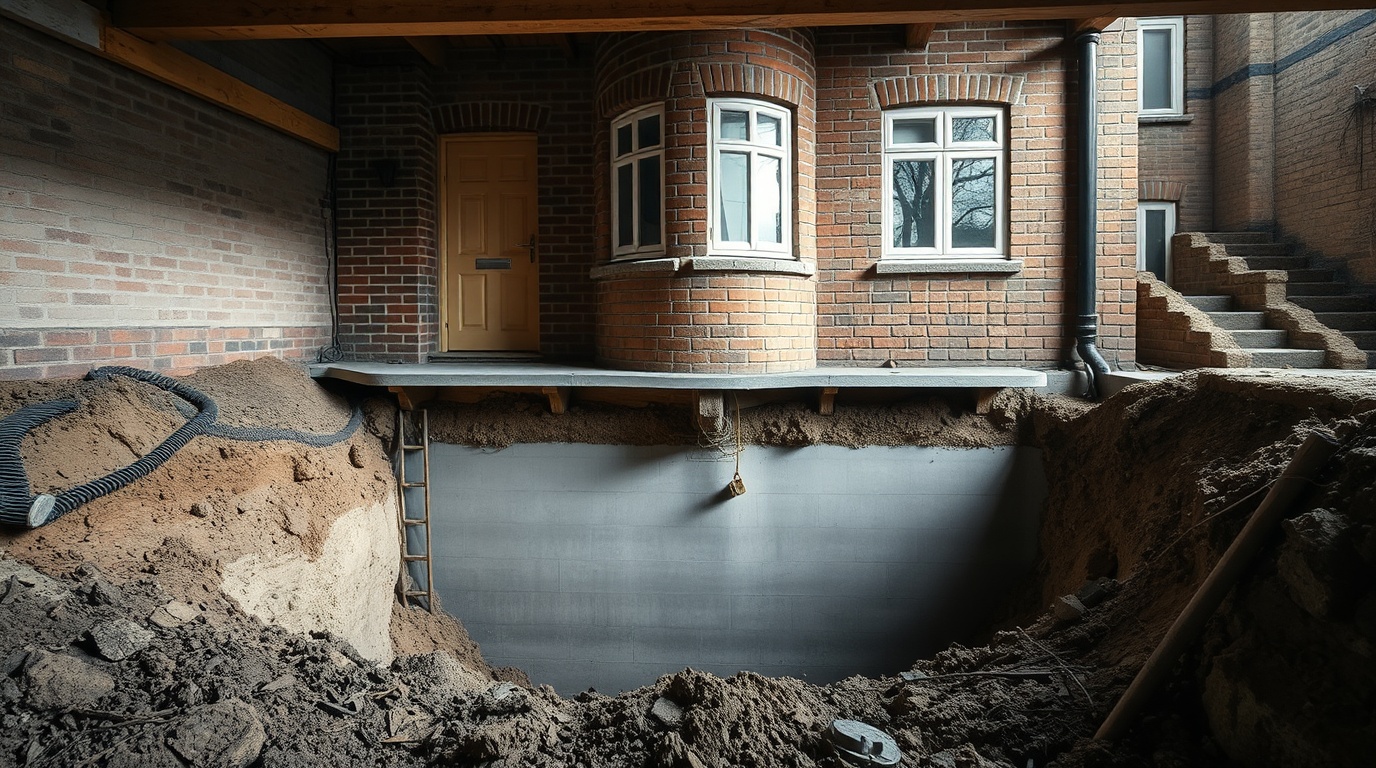
Extensions raise underpinning in two ways: supporting the existing house where it meets the new build, and choosing a foundation deep enough for the ground and any nearby trees. The figures below are typical UK ranges for guidance, not quotations.
Typical UK costs
- Underpinning to tie-in wallfrom ~£8,000
- Typical extension-related project£8,000–£30,000
- Mass concrete~£1,500–£2,500 / metre
- Trial holes / engineer designadded on top
- Tree within influencing distancemay force deeper / piled foundation
Why an extension can trigger underpinning
- Foundation depth mismatch: older houses often sit on shallow footings. A modern extension needs a deeper foundation, so the existing wall alongside is frequently underpinned down to the same level.
- Trees: Building Control and your engineer use the soil type and the species and distance of nearby trees to set foundation depth on shrinkable clay; this can mean much deeper trenches or piles.
- Drains: building over or near a drain may require it to be diverted or bridged, and a leaking drain can be the reason underpinning is needed at all.
- Boundary: excavating within three or six metres of a neighbour's structure brings the Party Wall Act into play.
| Situation | Typical figure | Notes |
|---|---|---|
| Underpin existing wall before tie-in | £8,000–£18,000 | depth to match new foundation |
| Deep trench fill near tree (clay) | £12,000–£25,000 | Building Control sets depth |
| Piled foundation (poor ground) | £20,000–£35,000+ | specified by engineer |
| Trial holes + engineer report | few hundred to low thousands | before design is finalised |
Indicative UK figures for guidance. Sources: Checkatrade and MyBuilder cost guides; Planning Portal Building Regulations.
Trial holes and Building Control
Before an extension foundation is designed, a trial hole is usually dug to expose the existing footing so its depth and condition are known. Your structural engineer uses that, plus the soil type and any tree survey, to specify the foundation and any underpinning. The work is then submitted to Building Control — either the local authority or an approved inspector — who inspect the open foundation before concrete is poured. On shrinkable clay near trees, the National House Building Council guidance on foundation depth is commonly followed, which is why a clay site with a mature tree can need a far deeper, and more expensive, foundation than a clay-free plot.
Trees, clay and foundation depth
On shrinkable clay soils, trees are the single biggest driver of foundation depth and therefore cost. Clay swells when wet and shrinks when dry, and a mature tree draws large volumes of moisture from the ground around it, so a foundation must reach below the zone affected by that seasonal movement. The deeper the influence, the deeper the trench fill or the longer the piles, and a clay site with a large oak nearby can need a foundation several times deeper than a tree-free plot. The species, the mature height and the distance of the tree all feed into the depth your engineer specifies, commonly following established NHBC foundation depth guidance. Removing a tree to avoid the cost is not a free option either — taking out an established tree on clay can trigger heave, the ground swelling back as it rehydrates, which can damage foundations in its own right. This is firmly engineer-and-Building-Control territory, not a decision to make on the day.
| Ground condition | Typical effect on foundation |
|---|---|
| Clay, no nearby trees | moderate depth trench fill |
| Clay with mature tree close by | much deeper trench or piles |
| Made-up / soft ground | piled foundation likely |
| Tree recently removed (clay) | heave risk — engineer advises |
General UK guidance. Sources: NHBC foundation depth principles and Planning Portal Building Regulations.
Boundaries, drains and Building Control
An extension near a boundary almost always engages the Party Wall etc. Act 1996, because excavating within three metres of a neighbour's structure (and to a lower depth than their foundation), or within six metres in certain cases, is notifiable. That means serving notice and, if the neighbour dissents, appointing surveyors and agreeing an award, with the building owner typically paying the reasonable surveyor fees. Drains are the other common complication: building over or close to a public sewer needs agreement from the water authority, and a drain may have to be diverted, bridged or protected. Throughout, Building Control — your local authority or an approved inspector — inspects the open foundation before concrete is poured and signs the work off. Budgeting for these statutory steps from the outset stops them appearing as nasty surprises once the extension is underway.
It is worth separating the two questions an extension raises, because they are priced differently. Supporting the existing house where it meets the new build is underpinning in the conventional sense, quoted per metre of the old wall brought down to the new foundation level. Choosing the right new foundation for the extension itself — deeper trench fill, or piles near a tree on clay — is a groundworks cost that belongs to the extension build, not to underpinning, even though the two happen together. Keeping them itemised separately on the quote stops the figures blurring into one alarming number and lets you see exactly what each part costs. It also makes the Building Control submission cleaner, since the inspector is approving the foundation design as a whole. Get the structural engineer to set both out clearly before you commit, so the foundation scope is fixed before the superstructure price is agreed.
A point that catches many homeowners out is the timing of the foundation decision relative to the rest of the build. If the extension is designed and priced on the assumption of a standard trench foundation, and the trial hole then reveals shallow existing footings or a tree within influencing distance, the foundation has to be redesigned — and that redesign almost always costs more than it would have to investigate the ground first. The lowest-cost path through an extension that touches underpinning is therefore the front-loaded one: commission the trial hole and the structural engineer before the extension drawings are finalised, so the foundation depth is known before the superstructure is priced. That sequence also keeps the Building Control submission clean, because the inspector is approving a coherent foundation design rather than a revised one. It is worth being clear with your builder that the foundation scope is provisional until the ground is investigated, so that the headline extension price is not mistaken for a fixed figure. An extension that needs underpinning is not unusually expensive when it is planned properly; it becomes expensive when the ground is discovered late and the design has to change after work has already started.
Frequently asked questions
Why does my extension need underpinning?
Usually because the existing house sits on shallower foundations than the new extension requires, so the existing wall is underpinned to match the depth, or because nearby trees or poor ground demand a deeper foundation. A structural engineer confirms what is needed from trial holes and a soil assessment.
Does building near a tree increase the cost?
It can significantly. On shrinkable clay, foundation depth is set using the tree species and distance, which may mean much deeper trench fill or piled foundations, both of which raise the cost compared with a tree-free clay-free plot.
Is underpinning for an extension covered by insurance?
Generally no. Buildings insurance covers subsidence damage to the existing home, not the foundations of a new extension, which is a planned construction cost you fund yourself. Check your policy for the exact wording.
Sources & further reading
- Planning Portal — Building Regulations and foundations
- Checkatrade — underpinning cost guide
- gov.uk — Party Wall etc. Act 1996: guidance
Figures on this page are typical UK ranges drawn from published sources and depend on your specific property. They are guidance, not a quotation.