The short answer
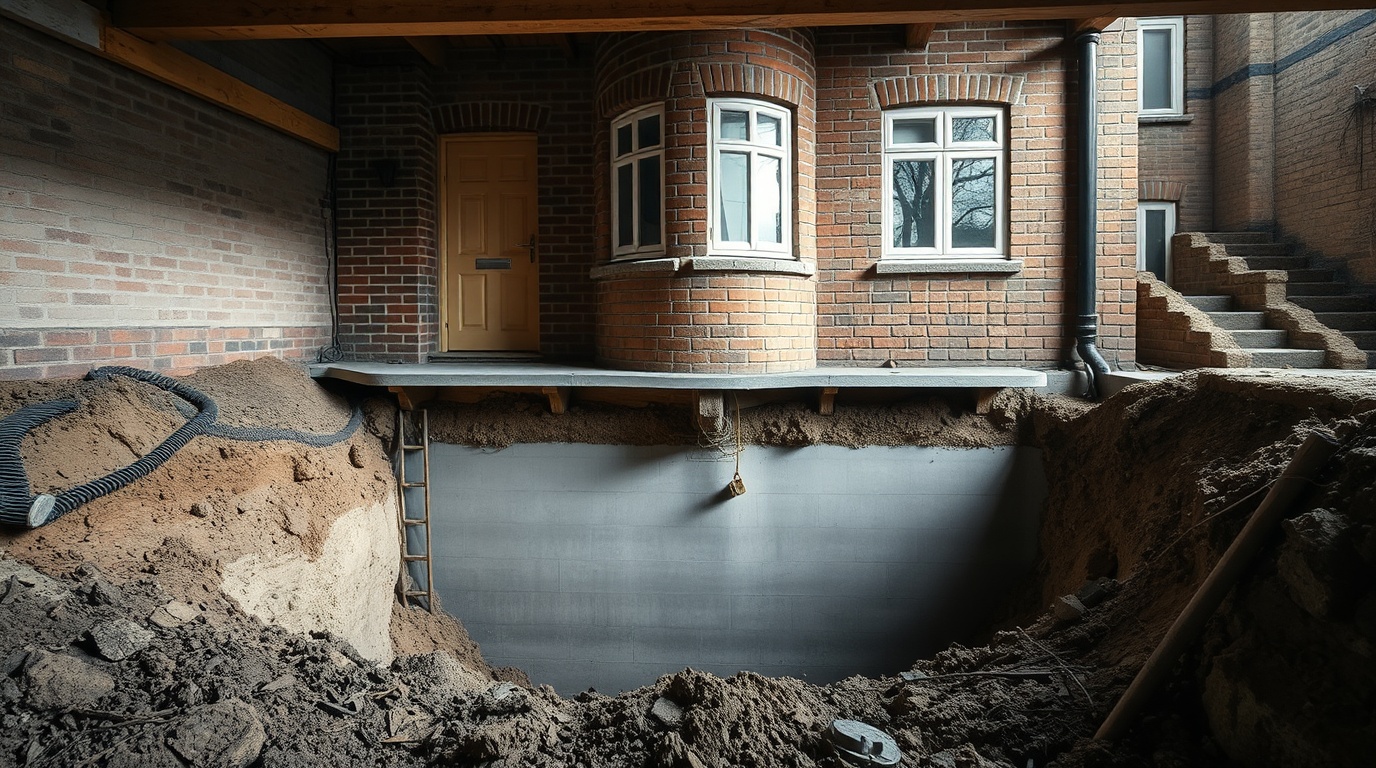
Partial underpinning — supporting only the affected section of a property rather than the whole perimeter — typically costs around £5,000–£20,000, against £20,000–£50,000+ for full underpinning, because you pay for far fewer linear metres. At a mass concrete rate of roughly £1,500–£2,500 per metre, a partial scheme of a few metres is a fraction of a full-house job. It is usually the correct engineering approach, not a corner cut: most subsidence is localised to one corner, wall or bay, so supporting the whole building would be unnecessary and wasteful. The one risk a structural engineer manages carefully is differential movement — if part of a building is underpinned to a deeper, stiffer foundation while the rest stays on its original footing, the junction between them must be detailed so the two parts move together. That design judgement is exactly why partial underpinning is engineer-led.
Partial underpinning is the norm, not the exception, because subsidence is usually localised. Done well it saves money without compromising the structure. The figures below are typical UK ranges for guidance.
Typical UK costs
- Partial underpinning~£5,000–£20,000
- Full underpinning~£20,000–£50,000+
- Mass concrete rate~£1,500–£2,500 / metre
- Usuallythe right, localised approach
- Key risk manageddifferential movement at junctions
Partial vs full
- Cost: partial is far cheaper because you support fewer metres — a few metres rather than the whole perimeter.
- Why it suits: most subsidence is localised to one corner, elevation or bay, so full underpinning would be supporting sound foundations needlessly.
- The risk: joining a deeper, stiffer underpinned section to the original shallow foundation can create a junction where the two move at different rates.
- The control: the engineer details that junction — sometimes with movement joints or by extending the underpinning slightly past the worst-affected length — so the structure behaves as one.
| Approach | Typical cost | When used |
|---|---|---|
| Partial underpinning | £5,000–£20,000 | localised movement (most cases) |
| Full underpinning | £20,000–£50,000+ | widespread / whole-perimeter movement |
| Monitoring only | investigation cost | where movement is old / stable |
Indicative UK figures for guidance. Sources: Checkatrade underpinning cost guide and RICS subsidence guidance.
Why partial is usually right
Underpinning more of a building than has actually moved adds cost without adding benefit, and can even introduce the differential-movement risk over a longer length. A structural engineer's job is to identify exactly which length of foundation is affected, confirm the rest is stable through monitoring, and design support only where it is needed. Insurers handling subsidence claims take the same view: they fund the repair shown to be necessary, which is frequently partial underpinning plus fixing the cause, not a blanket whole-house scheme. If a contractor recommends full underpinning without a soil investigation and monitoring data showing widespread movement, it is reasonable to ask why a more targeted scheme would not do.
How the engineer decides the scope
Defining how much to underpin is a structural judgement built on evidence, not a guess. The engineer typically starts with crack monitoring — measuring movement over a period, often spanning a seasonal cycle, to see where the building is actually moving and whether it is still active. A soil investigation shows the ground conditions along the wall, and a drains survey checks for the leaks that so often drive localised subsidence. From this the engineer identifies the affected length and decides whether to support, say, three metres or five, where to start and stop, and how to handle the junction with the sound foundations either side. The aim is to support exactly what has moved, plus a sensible margin for a gradual transition, and to confirm through monitoring that the rest is stable. That evidence-led scoping is what keeps partial underpinning both safe and economical.
| Evidence | What it tells the engineer |
|---|---|
| Crack monitoring | where and whether movement is active |
| Soil investigation | ground conditions along the wall |
| Drains (CCTV) survey | whether a leak is the cause |
| Level survey | the pattern and extent of settlement |
General UK guidance. Source: structural engineering practice and RICS subsidence guidance.
Partial underpinning and your insurance
Partial underpinning sits comfortably within how insurers handle subsidence claims. When a claim is accepted, the insurer's appointed engineer scopes the repair to what the evidence shows is necessary, which is frequently fixing the cause, monitoring, and underpinning only the affected length — not a blanket whole-house scheme. You pay the subsidence excess, commonly around £1,000, and the insurer funds the rest. The work is inspected by Building Control and, where a shared wall is involved, governed by the Party Wall etc. Act 1996. On completion the engineer issues a certificate of structural adequacy, which matters for partial schemes in particular, because a future buyer's surveyor will want reassurance that the unsupported sections were assessed and found sound, not simply ignored. Keeping that documentation protects the property's value and insurability.
A reassurance worth stating plainly is that choosing to underpin part of a building, rather than all of it, is not a corner cut but the standard professional response to how subsidence actually behaves. Ground movement is almost always localised — over a single failed drain, a soft patch, or one elevation affected by a tree — so supporting the whole perimeter would mean underpinning sound foundations that never moved, adding cost and a longer junction to manage for no structural benefit. Insurers and their engineers scope claims this way as a matter of course, funding the repair the monitoring and soil evidence show is necessary. The homeowner's job is simply to make sure the diagnosis is properly evidence-led and that the parts left untouched are explicitly assessed and recorded as stable. With that in place, partial underpinning is both the economical and the technically correct outcome, and the paperwork proves the scope was deliberate.
The reassurance worth stating plainly is that choosing to underpin part of a building rather than all of it is the standard professional response to how subsidence actually behaves, not a compromise on safety. Ground movement is almost always localised — over a single failed drain, a soft pocket, or one elevation affected by a tree — so supporting the whole perimeter would mean underpinning sound foundations that never moved, adding cost and a longer junction to manage for no structural benefit. Insurers and their appointed engineers scope claims this way as a matter of course, funding the repair the monitoring and soil evidence show is necessary rather than a blanket scheme. The homeowner's part is simply to make sure the diagnosis is properly evidence-led, and that the sections left untouched are explicitly assessed and recorded as stable in the engineer's report, so a future buyer's surveyor can see the scope was deliberate. With that documentation in place, partial underpinning is both the economical and the technically correct outcome. If a contractor proposes full underpinning without monitoring data and a soil investigation demonstrating widespread movement, it is entirely reasonable to ask why a more targeted scheme would not do the job.
Frequently asked questions
Is partial underpinning safe?
Yes, when designed by a structural engineer who details the junction between the underpinned and original foundations so they move together. Partial underpinning is the standard approach for localised subsidence and is usually the correct engineering call.
Why not just underpin the whole house?
Because most subsidence is localised, so underpinning sound foundations adds cost without benefit and can create a longer junction to manage. Engineers and insurers support only the length shown to have moved, with the rest monitored.
What is differential movement in underpinning?
It is the risk that an underpinned section, on a deeper stiffer foundation, moves at a different rate from the original shallower foundation it joins. The engineer details that junction to keep the structure behaving as one.
Sources & further reading
Figures on this page are typical UK ranges drawn from published sources and depend on your specific property. They are guidance, not a quotation.